There’s a point in every AI-driven testing journey when the theory stops being exciting and reality starts talking back.
Your RAG agents reason beautifully in notebooks, your dashboards sparkle with early wins — and then you plug it all into your CI/CD.
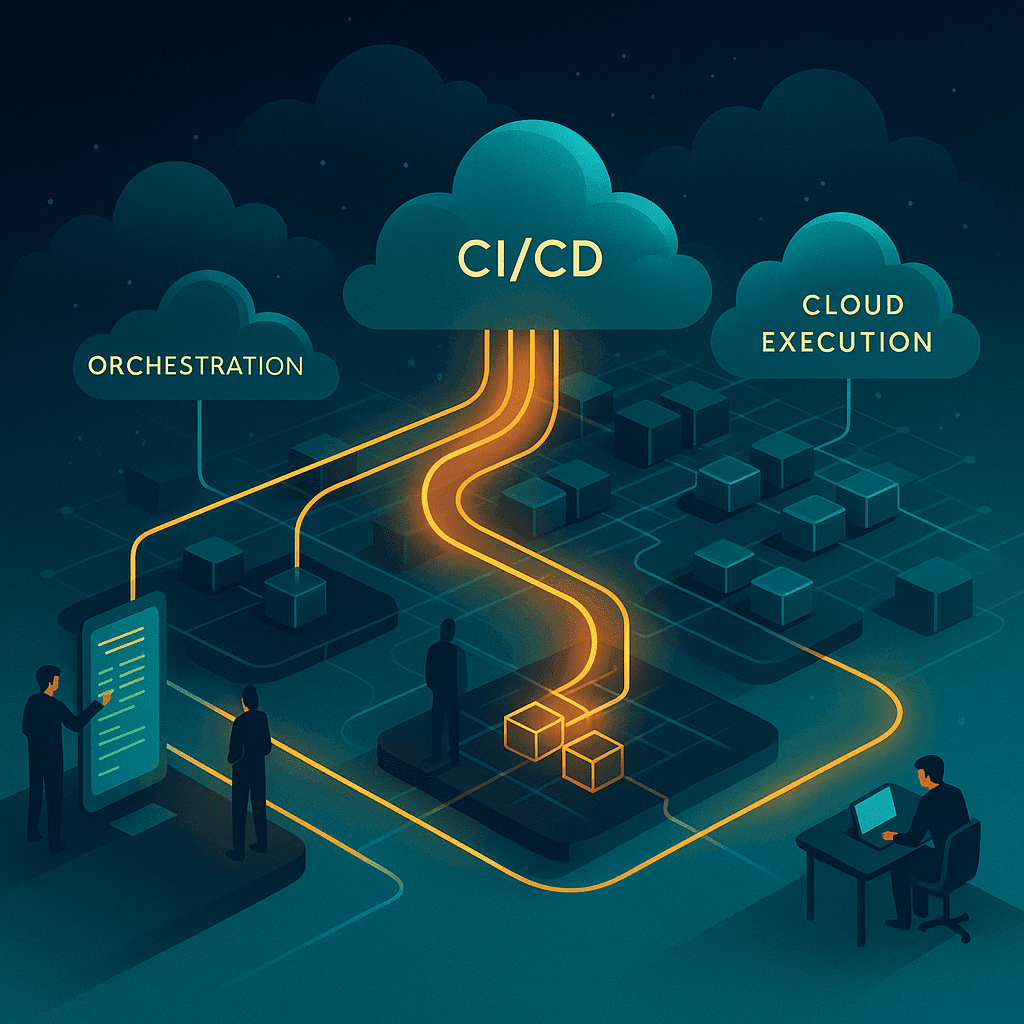
That’s when you realize: orchestration isn’t just about running tests; it’s about making intelligence runnable.
Pipelines fail in new ways. Agents collide. Cloud bills whisper warnings.
And yet, this is also where things get truly interesting — where a QE team stops “automating” and starts engineering intelligence at scale.
1. Why Deployment Feels Like Crossing a Canyon
Before deployment, everything lives in a controlled world. You can rerun, reset, or fake data until it behaves.
Once it hits CI/CD, you’re dealing with live triggers, unpredictable inputs, and a hundred ways for things to go sideways.
In a traditional setup, a pipeline is a choreographed sequence.
In an Agentic RAG QE setup, it’s more like an ecosystem — a set of thinking components that respond to changes, collaborate, and even argue about outcomes.
To deploy that successfully, you need more than Jenkins scripts; you need orchestration that understands context.
Lesson learned: In one of our early Omniit.ai rollouts, we cut runtime by 40% not by adding servers — but by letting agents decide which tests mattered most each build. That’s not optimization; that’s awareness.
2. The Orchestration Core: Giving Agents a Sense of Rhythm
Every orchestration story starts messy. There’s the “who does what,” the “when does it happen,” and the “where do results go.”
If those aren’t clear, the system starts talking to itself in circles.
So we build a Control Plane — a heartbeat that keeps every intelligent part in rhythm.
- Triggers watch for signals — a PR merge, a model update, or a new data slice.
- Planners translate that signal into an action plan — which agents to call, which tests to refresh.
- Executors handle the muscle work across containers or grids.
- Observers collect outcomes and send them home to the knowledge base.
What matters most here is not complexity, but clarity.
Agents can’t orchestrate well in chaos; they thrive when the system gives them order and freedom in balance.
Pro tip: Don’t bury orchestration logic in code. Describe it in manifests — YAML-style recipes that anyone can read, reason about, and tweak.

3. Scaling Beyond Machines — Scaling Intelligence
Scaling used to mean more VMs or devices.
Now it means more brains per minute — how many intelligent actions can your system take without human help?
You scale across three axes:
- Knowledge Parallelism: fetching different knowledge slices simultaneously.
- Execution Parallelism: running test plans on distributed clouds — serverless if possible.
- Feedback Parallelism: validating results concurrently with LLM-as-a-Judge evaluators.
One of our clients at Omniit.ai saw something fascinating: as we scaled, cost per intelligent action dropped while coverage quality rose.
Why? Because agents learned what not to test — and that’s where the real savings live.

4. When CI/CD Turns Proactive
Plugging this into CI/CD feels almost magical once it clicks.
A new commit lands, and without anyone touching it:
- The retrieval agent hunts for what changed.
- The planner maps which tests are at risk.
- The generator agent updates or repairs scripts.
- The executor runs them in Omniit.ai’s cloud grid.
- The observer learns from the outcome and updates the KB.
Instead of a passive pipeline, you get a living teammate.
It’s still DevOps — just one that thinks before it runs.

5. Seeing What the System Sees — Observability That Matters
You can’t manage what you can’t see, and with agentic systems, “seeing” goes deeper than pass/fail.
You want to know how the system reasoned and why it decided to skip or regenerate a test.
At Omniit.ai, our Quality Insights dashboard shows five categories of signals:
| Category | Metric | Why it Matters |
|---|---|---|
| Operational | Orchestration Latency | Tells if agents coordinate smoothly |
| Efficiency | Agent Reuse Rate | Measures knowledge retention |
| Accuracy | AI-Judge Validation Score | Gauges truth alignment |
| Scalability | Cost per Cycle | Keeps cloud usage honest |
| Learning | KB Drift Reduction | Tracks improvement over time |
Over time, you stop reacting to red bars and start listening to patterns — that’s how QE becomes intelligence management, not maintenance.

📊 Visual: Mini dashboard mockup with up/down trend arrows and color gradients.
6. What Experience Teaches You About Scale
No article or whitepaper will prepare you for that first week when orchestration meets production.
So here are truths you learn only by living them:
- Start small. Let agents practice on sandbox data before touching live CI.
- Instrument everything. Logs are the agent’s diary; keep them rich.
- Close the feedback loop early. Learning delayed is learning lost.
- Balance smart and cheap. A system that learns expensively is not sustainable.
- Celebrate every self-heal. Each one means your pipeline just got a little smarter.
We once watched a pipeline “decide” to skip flaky modules after two failed cycles. It wasn’t magic — it was data-driven intuition taking root.
7. The Road Ahead — Orchestrators That Think
Today’s orchestrators follow instructions.
Tomorrow’s will understand goals.
Picture this:
An orchestrator that predicts release spikes, adjusts test density by risk, pauses low-impact validations during high-cost hours, and rewrites its own configs for efficiency.
That’s the next evolution — orchestration with its own intelligence.
It’s what we’re building toward at Omniit.ai: a system that doesn’t just run quality — it reasons about it.
Closing Reflection
Deploying the Agentic RAG pipeline is where ideas meet gravity.
It’s messy, thrilling, and occasionally humbling.
But when you see agents collaborating across clouds, adapting in real time, and learning from every cycle — you realize this isn’t automation anymore.
It’s engineering consciousness into quality.
And once that happens, QE isn’t a phase in CI/CD — it’s the pulse that keeps the software alive.