It is easy to fall in love with shiny AI testing dashboards. They glow with promise: self-healing tests, intelligent agents, adaptive pipelines. But the fundamental question we need an answer is: Is all this intelligence actually making quality better?
That’s the question I had the first time our RAG-based test agents started generating their own scripts. The system looked magical. But when bugs slipped into production, it hit me hard: we weren’t measuring what mattered.
Let’s dive into the heart of that realization — how to define and monitor quality metrics that truly reflect intelligence, learning, and value in an Agentic RAG QE ecosystem.
Because without the right metrics, even the smartest AI feels blind.
1. Why Metrics Matter More Than Ever
In a traditional QE setup, metrics are like end-of-sprint scorecards: how many tests ran, how many passed, how many bugs logged.
But in an Agentic RAG QE system, metrics have a bigger new duty : they must guide the system itself.
Here’s the shift:
- Old world metrics describe performance.
- Agentic metrics drive adaptation.
The data you track is what your agents learn from. It influences prompt refinement, self-healing triggers, even which tests the system decides to prioritize, and etc.
Think of it like teaching junior testers. If you only ever say “you passed” or “you failed,” they never learn why. But if you show them patterns like how context changed, why a selector broke, what response drifted, they will grow faster.
Agents are the same way.
| Traditional QE Metric | Agentic QE Metric |
|---|---|
| Test case pass/fail | Adaptation success rate — how often a test heals itself successfully |
| Coverage percentage | Knowledge coverage — how much updated system context the AI truly understands |
| Defect density | Fault correlation rate — how many failures are caused by incorrect reasoning or outdated retrievals |
| MTTD (Mean Time to Detect) | MTTA (Mean Time to Adapt) — how long it takes the system to self-adjust |
2. Quality Has Layers — And Each Tells a Story
We used to talk about quality as one number. Now it’s a tapestry.
In Agentic QE, every layer — the system, the model, the agent, and the test — has its own version of “quality.”
Here is the breakdown:
- System Quality: Is the RAG pipeline fetching the right context?
- Model Quality: Are the generated artifacts accurate, relevant, and safe?
- Agent Quality: Are reasoning steps traceable and consistent?
- Test Quality: Are tests adapting effectively to change?
Each of these layers produces signals worth tracking — some quantitative, others more interpretive.
Examples:
- Retrieval precision → Are the docs being pulled relevant to the change detected?
- Adaptation latency → How quickly can an agent fix a broken test?
- Feedback incorporation rate → How often are newly discovered defects enriching the knowledge base?
Instrument these dimensions will stop measuring just “how many tests you ran” and start showing how fast your system is learning.

3. Continuous Metric Feedback Loop
If you’ve read earlier blogs (, Agentic RAG QE Architecture, Agentic RAG QE Framework, and Pipeline Orchestration) , you know Agentic QE thrives on loops — retrieve, reason, act, learn. Metrics are the pulse that keeps that loop alive.
In this flow:
Retrieve → Generate → Execute → Observe → Learn → Adapt
Each stage emits its own signals — and those signals aren’t just for human; they feed back into the system so it can self-improve.
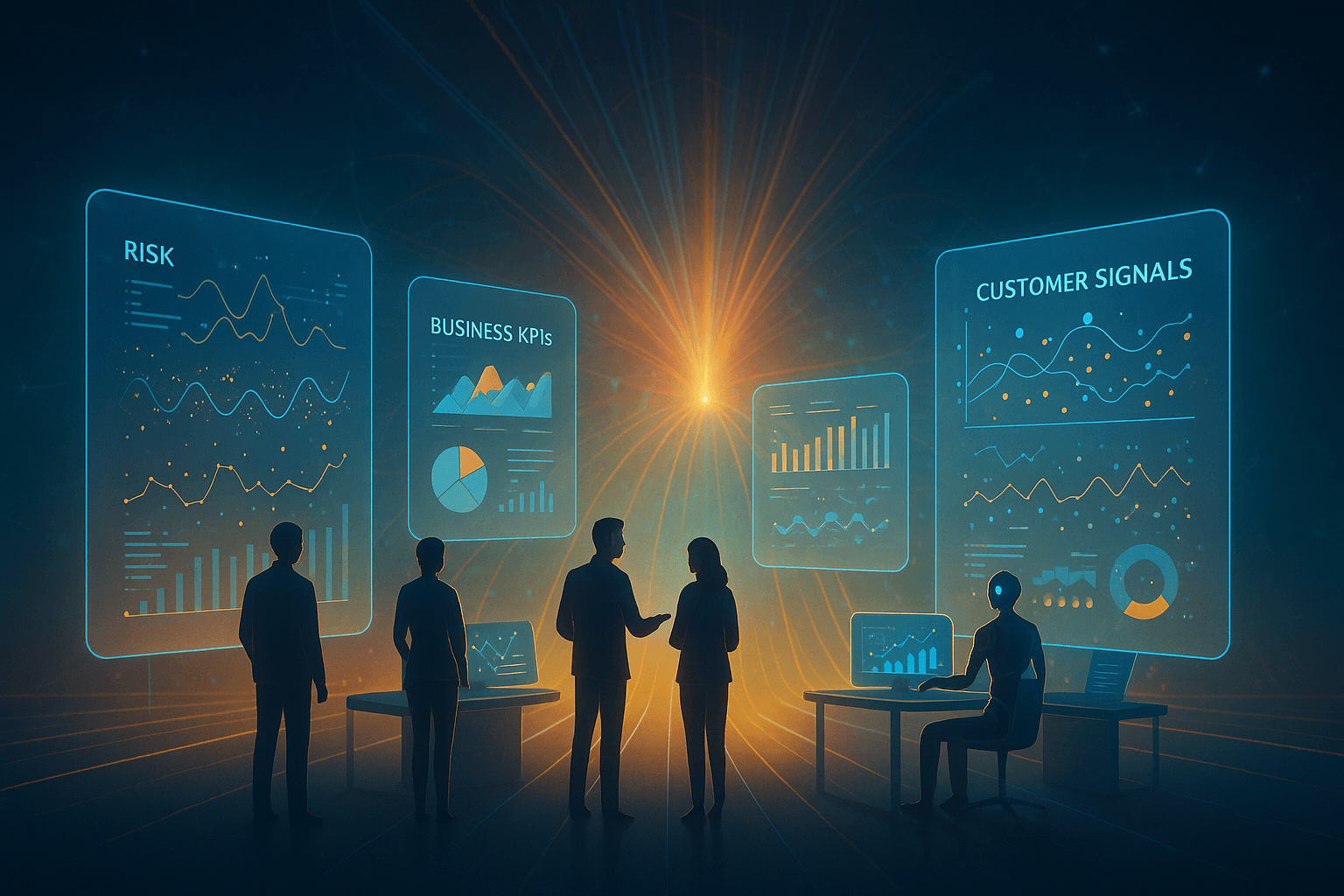
Quality Insights Dashboard for Agentice RAG QE system doesn’t just report success rates; it surfaces learning velocity, retrieval drift, and adaptation patterns in real time.

4. Moving Beyond Static KPIs
You can’t run a self-learning system with static KPIs.
Traditional metrics assume stability, which is not true. The codebase, APIs, and prompts evolve daily. That’s why we introduced adaptive signals — metrics that move as your system learns.
Some examples that proved game-changers in practice:
- Dynamic Baseline Drift: Detects when test expectations are outdated.
- Agent Confidence Delta: Monitors if your agents are losing certainty in their predictions.
- Knowledge Drift Rate: Reveals when retrieval accuracy starts decaying.
- Automation ROI Ratio: Balances automation effort vs. measurable business value.
These aren’t vanity numbers. They’re decision tools. They tell you when to step in, when to retrain, and when to trust the system to self-correct.

5. When Metrics Meet Business Outcomes
Are you struggling with getting a QE seat at the leadership table?
Metrics are powerful, but they mean little unless they connect to why your business cares. In an Agentic QE setup, that bridge becomes clearer than ever.
By correlating technical intelligence with business results, you can finally answer questions like:
- Are we releasing faster without adding risk?
- Are our self-healing tests actually reducing quality cost?
- Are fewer customer-reported bugs showing up post-release?
Omniit.ai’s Quality ROI Insights analysis visualizes this link — it doesn’t just count test cases; it maps automation performance to tangible product outcomes.
6. The Infrastructure Behind Intelligent Metrics
To get here, you need a solid foundation. A few lessons from experience:
- Unify your data. Metrics from RAG components, execution logs, and LLM evaluations should all flow into a single observability layer.
- Stream metrics in real time. Use dashboards not as reports, but as live monitors of reasoning health.
- Automate alerts. When adaptation latency spikes or retrieval precision drops, your system should notify you before users do.
- Evaluate AI-generated outputs. Use an LLM-as-a-Judge setup to score test validity or bug summary quality over time.
A typical tech stack might look like:
LangChain + Pinecone for context metrics
Prometheus + Grafana for runtime observability
Omniit.ai Cloud Metrics Engine for agent and adaptation tracking

7. The Human Touch: The Most Important Metric
Even in the most autonomous systems, quality is still about trust.
No dashboard can measure confidence between humans and AI — but that trust is what keeps adoption sustainable.
That’s why at Omniit.ai, we blend quantitative and qualitative evaluation:
- Agents report what they did and why.
- Engineers annotate feedback that informs retraining.
- Product owners get transparent visibility into how quality improves over time.
It’s not just observability — it’s accountability with empathy.
8. Final Thought: Metrics Are the Common Language
At the end of the day, metrics are how humans and agents talk to each other. They translate complex behaviors into something we can trust, and something the system can learn from.
In an Agentic RAG QE system, the metrics aren’t static numbers. They’re rather living signals that tell you where the intelligence is thriving, where it’s drifting, and how fast it’s growing.