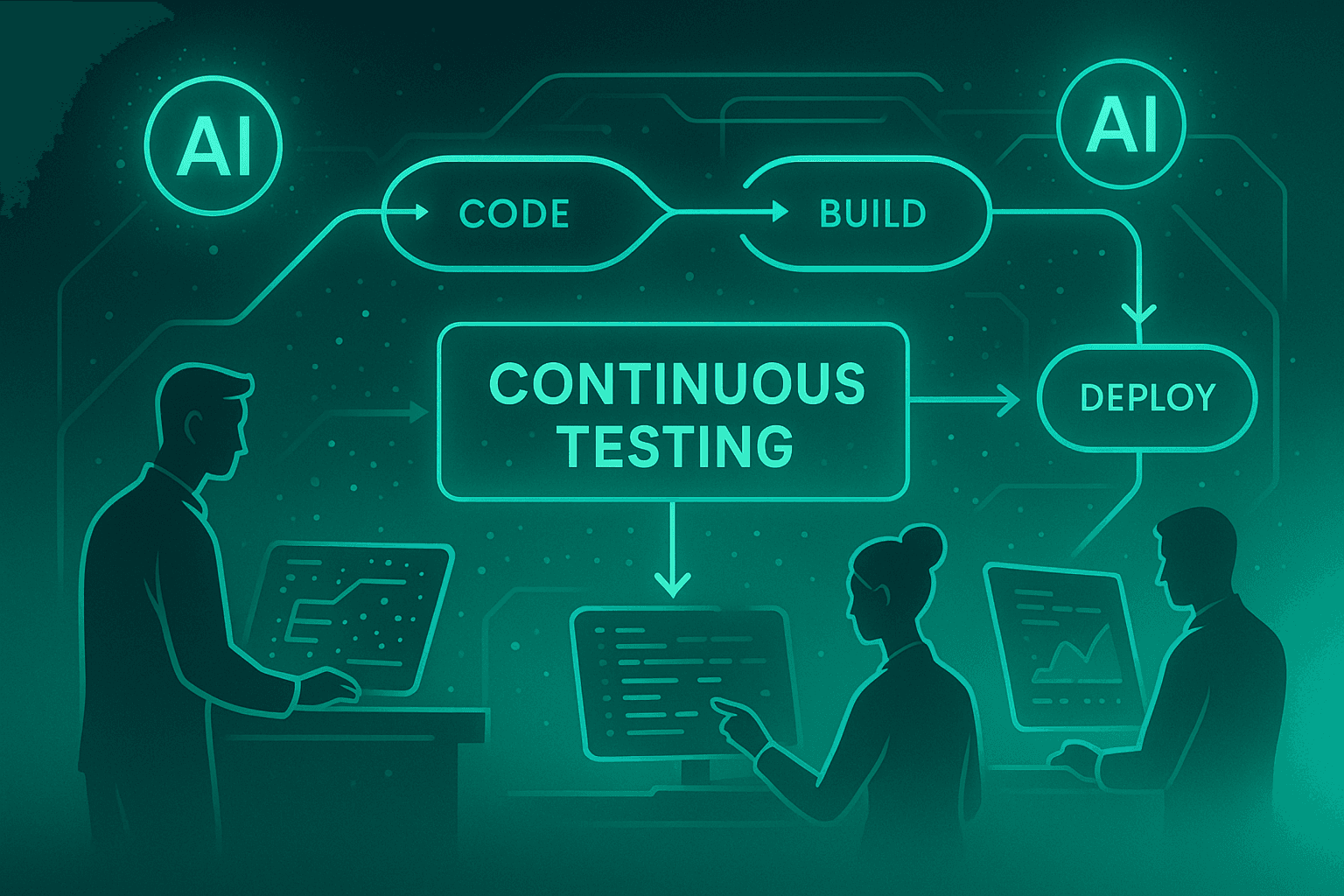

Here is the uncomfortable truth: your “green CI” doesn’t mean your AI feature is safe to ship!
If you’ve ever shipped a release where automated tests were green… and production still lit up, you already understand the heart of the LLM era:
- The system can change without code changing.
- The same input can produce different outputs.
- “Correctness” often depends on context, tone, user intent, and facts—sometimes all at once.
That’s why LLM evaluation isn’t an “ML team thing.” It’s the next evolution of QA/QE’s job: turning uncertainty into measurable confidence.
And a bigger reason why this matters: organizations are quickly adopting generative AI, while governance and risk guidance (like NIST’s AI Risk Management Framework and its Generative AI profile) explicitly calls out trustworthiness, measurement, and evaluation as part of responsible AI practice.
1) Why LLM systems break classic QA assumptions
Traditional QE is built on a few “quiet” assumptions:
- Inputs and outputs are predictable enough to assert.
- The oracle (expected result) is stable.
- Failures are mostly deterministic: re-run and reproduce.
LLMs challenge each one.
Even if your application code is deterministic, model behavior is probabilistic. Prompt wording, temperature, hidden safety policies, retrieval results, tool responses, and even vendor updates can alter outputs. That’s not a reason to fear LLMs—it’s a reason to upgrade our QA mental model.
So instead of asking “Did it pass?” we often need to ask:
- Did it stay within acceptable quality bounds?
- Did it remain factual (especially for RAG)?
- Did it follow policy and safety constraints?
- Did it use tools correctly (for agentic workflows)?
- Is it reliable across attempts and user variations?
This is exactly why evaluation becomes the center of the work.
2) What “LLM evaluation” really means (for QA/QE)
In practice, LLM evaluation spans two layers:
A) Output quality evaluation (what QE usually owns)
Common dimensions include:
- Helpfulness / task success
- Relevance
- Factuality / faithfulness
- Clarity and completeness
- Style / tone alignment
- Safety and policy compliance
B) System evaluation (what QE increasingly co-owns)
- Latency, uptime, cost
- Regression stability across model versions
- Data / retrieval drift
- Tool-call accuracy
- Monitoring signals and incident response
| LLM Quality Dimension | What to Test (Concrete Checks) | How to Measure (Practical Metrics) |
|---|---|---|
| Task Success / Usefulness | User goal achieved; required steps present; constraints followed | Rubric pass/fail, task completion rate, first-response resolution |
| Relevance | Answers the actual question; avoids tangents; uses provided context | Relevance pass rate (rubric/judge), off-topic rate, context-use yes/no |
| Factuality | Claims are correct; no invented details; numbers/dates accurate | Claim-level accuracy (% correct), hallucination rate, critical-claim error rate |
| Faithfulness to Sources (RAG) | Stays within retrieved evidence; no contradictions; cites correctly (if required) | Supported/unsupported claim rate, contradiction rate, grounding adherence rate |
| Safety / Policy | Refuses disallowed requests correctly; avoids unsafe instructions | Policy violation rate, refusal correctness (precision/recall on labeled set), jailbreak success rate |
| Format / Schema Compliance | JSON/schema valid; required fields present; constraints met | Schema validation pass rate, parsing failure rate, missing-field rate |
| Robustness to Prompt Variations | Stable across paraphrases/typos; doesn’t flip decisions unexpectedly | Consistency score across paraphrases, metamorphic test pass rate, score variance |
| Reliability / Stochastic Stability | Same prompt succeeds repeatedly; low flakiness | Pass^k (all k succeed), intermittency rate, score variance across runs |
| Tool Selection (Agents) | Calls tool when needed; avoids tools when not needed; no hallucinated tools | Tool routing accuracy, tool omission rate, wrong-tool rate, tool hallucination rate |
| Tool Arguments & Synthesis (Agents) | Valid args; handles missing context; interprets tool outputs correctly | Argument validity pass rate, missing-context rate, incorrect synthesis rate, recovery success rate |
3) Human evaluation: still the gold standard—if you treat it like engineering
The “ideal” evaluation is human review. But humans are expensive, slow, and (importantly) inconsistent.
That inconsistency is measurable. Inter-rater reliability is a real engineering concern, and classic metrics like Cohen’s kappa exist specifically because raw agreement can be misleading.
What this means for QE teams:
- Create crisp rubrics (“pass/fail” often beats 1–5 scales when you want consistent judging).
- Run calibration sessions when raters drift.
- Track reliability as a health metric, not a blame metric.
If you can build consistent human labels on a small “golden set,” you’ve created a powerful anchor for everything else.
4) Rule-based metrics: useful… and also dangerously comforting
Before LLMs, NLP evaluation leaned heavily on overlap metrics:
- BLEU for translation
- ROUGE for summarization
These metrics are fast and repeatable. The catch is the same catch QE knows from brittle UI assertions:
If the wording changes but the meaning stays correct, overlap metrics may fail you.
They can still be useful in constrained settings (templates, strict summaries, structured outputs). But for open-ended assistants, they often correlate poorly with what users feel as “good.”
So for modern QE: treat overlap metrics like unit tests—valuable, but not sufficient for user-level quality.
5) LLM-as-a-Judge: the biggest shift in practical evaluation
Here’s the modern move: use a strong LLM to evaluate another LLM’s output.
The idea has been studied in depth (including known limitations and biases), and it’s become a mainstream pattern for grading open-ended responses.
Two common judging modes
- Pointwise: grade one answer against criteria (pass/fail, or a score).
- Pairwise: compare answer A vs answer B (often more stable for preference decisions).
Why QE should care
Because it looks like what we already do—just with a new kind of oracle.
- We define acceptance criteria.
- We demand structured outputs.
- We detect regressions across versions.
- We investigate failures using rationales.
But you must know the failure modes
LLM judges aren’t neutral. Research highlights several biases:
- Position bias: preferring the first option
- Verbosity bias: mistaking “longer” for “better”
- Self-enhancement bias: favoring outputs similar to the judge’s own style
Practical mitigations (QE-friendly):
- Swap A/B order and majority vote.
- Explicitly instruct the judge to ignore length.
- Use a different (often stronger) model for judging than the one generating.
- Keep temperature low for reproducibility.
This is “test flakiness control,” just translated into LLM terms.

6) Factuality evaluation: the RAG reality check QE must own
RAG makes LLMs more grounded—when retrieval is good. But it also creates a new class of bugs:
- The model cites irrelevant chunks.
- The right chunk is retrieved, but the model ignores it.
- The model blends retrieved truth with hallucinated “glue.”
A common modern approach is:
- Extract claims/facts from the response
- Verify each claim against a source (retrieval/web/KB)
- Aggregate into a factuality score (optionally weighted by importance)
This is exactly the kind of decomposition QE teams are great at: breaking an untestable blob into testable units.
And if your team is building RAG features, this becomes a first-class test dimension—not an afterthought.
7) Agent and tool evaluation: where QE skills become a superpower
Once LLMs start calling tools, “quality” is no longer just language quality. It becomes workflow correctness:
- Did it choose the right tool?
- Did it pass valid arguments?
- Did the tool return meaningful structured output?
- Did the agent synthesize results correctly?
Benchmarks have emerged to evaluate this tool-agent-user loop. For example, τ-bench is designed to test agent performance in real-world domains with tools and policy constraints.
This is deeply familiar territory for QE:
- Tool routing errors look like integration misconfigurations.
- Tool hallucinations look like API contract failures.
- Bad synthesis looks like a transformation/ETL bug.
- Silent tool failures look like missing observability.
Here we share a sample “Agent Failure Modes Cheat Sheet”:
| Agent failure mode | What it looks like in real life | Likely root cause | What to test (QE-style) | Mitigation / fix |
|---|---|---|---|---|
| Punt (doesn’t use tools when it should) | “Sorry, I can’t help” or gives a generic answer when a tool is clearly needed | Tool router recall miss; prompt doesn’t enforce tool use; weak tool-use policy | Route coverage tests (“must call tool” prompts); negative tests (no tool needed); log-based detection of “no tool called” | Improve router recall; strengthen system prompt (“use tools when required”); add examples; add guardrail that blocks non-tool answers when tool required |
| Wrong tool chosen | Uses email tool instead of calendar; searches web instead of internal KB; calls “create” when should “read” | Overlapping tool scopes; ambiguous tool descriptions; router ranking issue | Tool confusion matrix; A/B prompts with near-neighbor intents; tool selection unit tests | Clarify tool docstrings + names; tighten scopes; router retraining/tuning; add disambiguation prompt step (“confirm intent”) |
| Tool hallucination (nonexistent function) | Calls find_bear() when only find_teddy_bear() exists | Weak grounding; tool list not visible; vague instruction “use any tool” | Contract tests: ensure tool name always in allowed list; fuzz prompts; check for “unknown tool” rate | Enforce structured tool calls; tighten top-level instruction (“only call listed tools”); rename tools to be obvious; upgrade model if consistently weak |
| Correct tool, wrong arguments | Coordinates are 0,0; wrong date range; missing required IDs | Missing context; schema unclear; model guessing; poor arg constraints | Argument validation tests; property-based tests on inputs; “missing context” prompts | Add arg validators + defaults; add a “get_context” tool (location/user profile); require clarifying question instead of guessing |
| Argument format/type errors | Tool call fails: string vs int; malformed JSON; invalid enum | Loose schema; no structured output; tool API poorly specified | Strict schema validation; negative tests for type mismatch; parsing error rate | Use structured outputs; publish JSON schema; provide examples in tool docs; auto-repair layer (light) before execution |
| Tool router recall miss (tool not surfaced) | Model claims no tool exists; calls a generic tool because the right one wasn’t presented | Router optimized too aggressively for precision; embeddings mismatch | Router recall suite; track “needed tool absent” events; audit top-k tool list | Increase router recall; add synonym expansion; improve tool metadata; multi-stage router (broad → narrow) |
| Tool execution error | Tool returns exception, timeout, 500; agent stops or apologizes vaguely | Tool bug; unstable dependency; rate limits; poor error mapping | Tool integration tests; chaos tests (timeouts); retry policy tests | Fix tool; implement retries/backoff; return structured errors; add fallback path (alternate tool or graceful degrade) |
| Silent tool output (returns nothing/None) | Agent confidently confirms action but tool never reported status | Tool doesn’t return confirmation; missing output contract | Contract tests: every tool returns structured status; monitor “empty output” frequency | Always return structured result (even empty list); include status, reason, next_action fields |
| Overlong tool output (too much data) | Agent ignores the key item; responds incorrectly or vaguely | Tool returns noisy payload; context overload | Output-size tests; sampling tests with large results; relevance tests | Summarize/trim tool output; return top-N; include “primary_result” field; move raw payload behind a pointer |
| Incorrect synthesis of tool results | Tool finds “Teddy 1 mile away,” agent says “no bears found” | Model missed fields; output |
If your org/team is adopting “AI agents,” QE professionals who understand agent evaluation will quickly become the people leadership trusts—because you can explain why the agent failed, not just that it failed.
8) Benchmarks: helpful as a profile, not a promise
Benchmarks are still important—but only if you interpret them like an engineer, not like marketing.
Examples:
- MMLU measures broad academic and professional knowledge across many tasks.
- SWE-bench evaluates whether a model can generate patches that resolve real GitHub issues and pass tests.
Benchmarks tell you a model’s shape—strengths and weaknesses. They do not guarantee your product use case will work. The gap is where QE lives.
Your job isn’t to pick the top benchmark model. Your job is to build an evaluation harness that reflects your users, your risks, your workflows.
Here’s a QE-native way to start, without boiling the ocean.
9) A practical LLM evaluation playbook for QA/QE teams

Step 1: Define “quality” like a contract
Pick 3–6 dimensions that matter for your feature:
- Task success
- Factuality (if RAG)
- Safety/policy
- Format/style constraints
- Tool correctness (if agentic)
- Latency/cost thresholds (system SLOs)
Step 2: Build a “golden set” (your new regression suite)
- 50–300 real prompts (seed from production logs if possible)
- Include edge cases, ambiguity, adversarial inputs, multilingual if relevant
- Store expected outcomes as:
- human labels, or
- rubric-based acceptance criteria
Step 3: Choose evaluation layers
- Fast checks: structured output validation, regex rules, safety filters
- LLM judge: pointwise + pairwise comparisons for quality
- Human audit: small weekly sample to keep your judge honest
Step 4: Control judge risk (like test flakiness)
- Fixed rubric + low temperature
- Order swapping for pairwise
- Track judge drift over time
- Periodically re-align with humans (kappa-style reliability checks)
Step 5: Make results actionable
Don’t stop at scores.
- Capture judge rationales
- Cluster failure modes (hallucination, missing steps, wrong tool, policy violations)
- Turn clusters into backlog items: prompt changes, retrieval tuning, tool contract fixes, guardrails, fine-tuning targets
This is how evaluation becomes engineering leverage—not just reporting.
Closing: “Meaningful QA” is becoming “Measurable Trust”
The best QA/QE professionals have always been translators:
- between product intent and technical reality,
- between risk and release decisions,
- between what “should happen” and what actually happens.
LLM evaluation is simply the next language you need to speak.
When you understand LLM evaluation principles—human rubrics, reliability, judge bias, factuality decomposition, tool/agent correctness—you don’t just “test AI.” You help your organization ship AI with trust.
And in 2026, that’s what meaningful QA/QE looks like.